
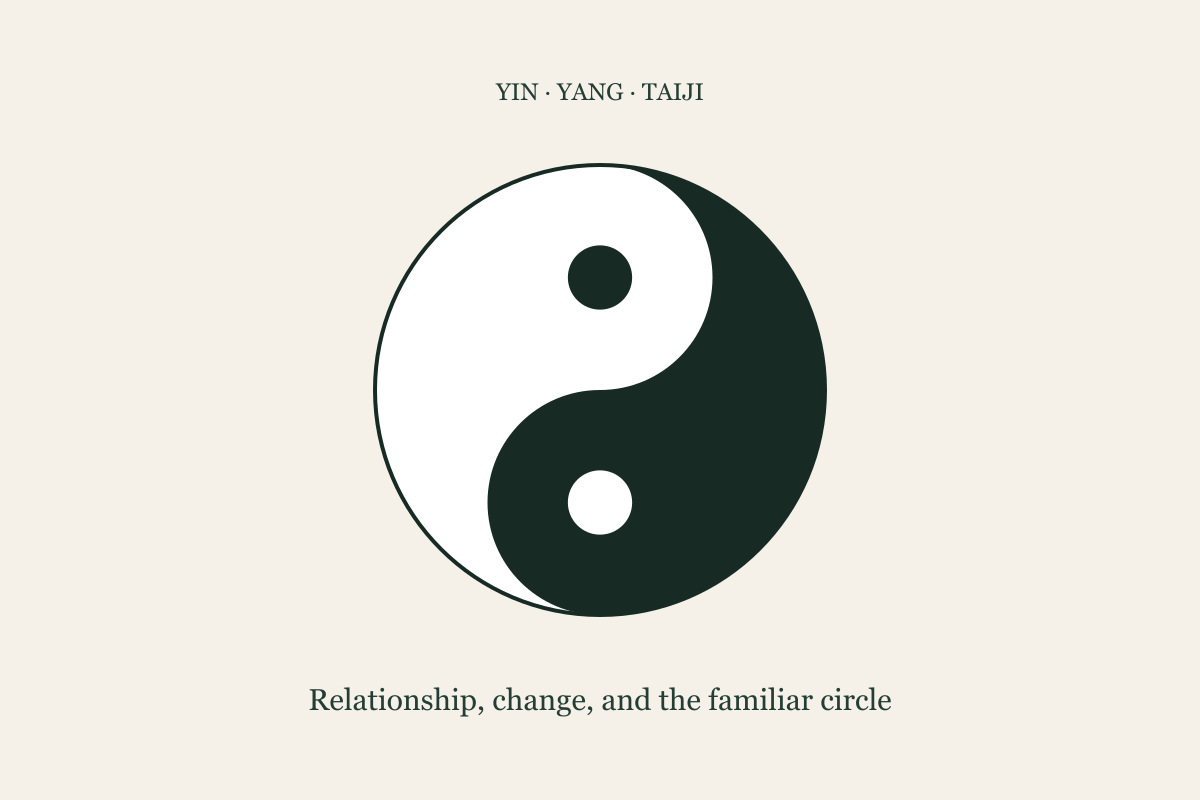
TaoWards’ diagram of the familiar taijitu: two interlocking halves, each with a dot of the other color.
Look closely at the yin yang symbol. A white dot sits inside the dark half; a dark dot sits inside the white. Even before you know its name, the design gives you a clue: neither side stands entirely alone.
This familiar circle is a taijitu, a diagram of taiji. Its two halves give shape to yin and yang: contrasting qualities that depend on one another and change in relation to one another. The curve and the dots make that relationship visible. To understand the symbol, start with those details, then follow the ideas behind them.
Yin and yang begin with shade and sunlight
The early meanings of yin and yang are grounded in a landscape: the shaded and sunlit sides of a hill. Imagine walking around that hill. The cooler slope and the warmer slope belong to the same place. Their difference depends on their relationship to the sun.
From those concrete meanings, yin and yang came to describe qualities such as stillness and activity, coolness and warmth, inwardness and outwardness. The Internet Encyclopedia of Philosophy’s account of yinyang explains their interdependence and changing relationship. Yin and yang belong to a wider Chinese intellectual tradition that includes both Taoist and Confucian thought.
Thinking in relationships also changes the question you ask. Instead of deciding whether something is permanently yin or yang, look at what it is doing and what you are comparing it with. A pause within a conversation has a different place from a silence that lasts all evening.
What the old texts say about living together
In chapter 2 of the Tao Te Ching, also called the Dao De Jing, long and short, high and low, and before and after take their meaning from one another. This is a foundational Taoist text associated with Laozi. Its examples begin with distinctions anyone can recognize: something is long beside something shorter; a person can be ahead only in relation to someone behind.
Chapter 42 brings yin and yang directly into the picture. It describes all things as carrying yin and embracing yang, with harmony arising through qi, the vital breath of traditional Chinese thought. Both qualities take part in the life of things. Harmony depends on their relationship.
Read those passages together, and the two halves of the symbol become easier to understand. Difference makes a relationship possible. A conversation, for example, needs room for a voice and for someone to receive it. Speaking all the time would leave no room for listening; listening without ever answering would change the exchange too. The exchange takes shape through both.
How to read the yin yang symbol
The familiar design gathers that relationship into a circle. Columbia University’s introduction to the Chinese cosmos places yin and yang within a view of nature as an interconnected, changing whole. Four visible features help you read the drawing.
The circle: one whole
The outer edge holds both halves together. Cover either half with your hand and the design is incomplete. The circle makes their relationship visible: each belongs within something larger than itself.
The dark and light halves: contrasting qualities
The dark area represents yin; the light area represents yang. They can bring to mind shade and sunlight, stillness and activity. White does not mean moral goodness, and black does not mean evil. Both are necessary to the symbol’s meaning.
The curve: a changing relationship
Follow the dividing line with your eye. Where one shape widens, the other narrows. The curve makes the image feel as though it is turning, giving visual form to the waxing and waning of yin and yang. Think of daylight lengthening toward summer and shortening toward winter: the year keeps moving.
The dots: each contains something of the other
The dots interrupt any idea of two sealed worlds. Each half carries the other color within it. A common reading is mutual presence and the possibility of change. Even within the broadest part of one color, the other is present.
Taiji, the Book of Changes, and a philosopher’s question
Taiji is often translated as “Supreme Ultimate.” Here, it concerns how a differentiated world belongs to one underlying whole. The word tu means diagram, giving us taijitu: a picture through which to consider that idea.
The Appended Statements of the Yijing, or Book of Changes, describes taiji giving rise to two modes, then four images, then eight trigrams. Trigrams are groups of three broken or unbroken lines. This passage connects an account of the world with the signs used in a classical book of divination and reflection.
In the eleventh century, the thinker Zhou Dunyi (1017–1073) explored the relationship through activity and stillness. His Explanation of the Taiji Diagram describes activity generating yang and stillness generating yin, each giving way to the other. The scholar Joseph A. Adler discusses this account in “Stillness and Activity”.
His diagram uses several connected elements to describe how the world takes shape. In his account, activity reaches a point of stillness, and stillness gives way to activity again. Neither can be understood as an isolated, permanent state.
Where these ideas entered people’s lives
The Book of Changes gave readers a way to consider circumstances through changing lines and images. Chapter 2 of the Appended Statements describes studying those images at rest and attending to change when taking action. Its account of divination includes arranging yarrow stalks to establish the figures. The symbols belonged to an activity: pausing over a question, reading a configuration, and considering how a situation might develop.
Later thinkers also asked how stillness and activity mattered in the cultivation of character. Adler describes the twelfth-century philosopher Zhu Xi working through the relationship between a quiet mind and its response to events. Quiet sitting had a place in that discussion. Stillness could prepare a person to meet the world with attention.
These examples give the symbol a fuller setting. A diagram could help someone study an account of nature; a text could guide reflection before action. The concern reaches beyond a pleasing arrangement of black and white to how a person understands and responds to change.
Carrying the meaning into your own day
Imagine finishing a difficult week. The work is sent, the laptop is closed, and you finally have an hour to yourself. Yet you pick up your phone and refresh your inbox. Nothing needs your answer, but you check once more. After days of being needed, an unclaimed hour can feel strangely difficult to accept.
The yin yang symbol offers a way to think about that moment. Effort has had its place. Now there may be room to cook slowly, hear a whole song, or sit with someone without checking the time. In this personal reading, allowing rest is part of taking your life seriously.
Another day may ask for the reverse: speaking when you have been holding back, or taking a first step after a long period of waiting. Balance involves noticing what the situation calls for. It does not require giving every activity the same number of minutes.
A symbol you wear can hold that question close. Our yin yang ring offers one way to keep that intention within sight: room for effort, and room to enjoy what the effort is for.

Given to someone you care about, it can express a wish that leaves room for the whole person: may you have energy for what matters to you, and time to enjoy the life around it.
Look back at the two dots. Each half already makes space for the other. That small detail can change the way you read the circle, and the way you think about the next part of your day.