
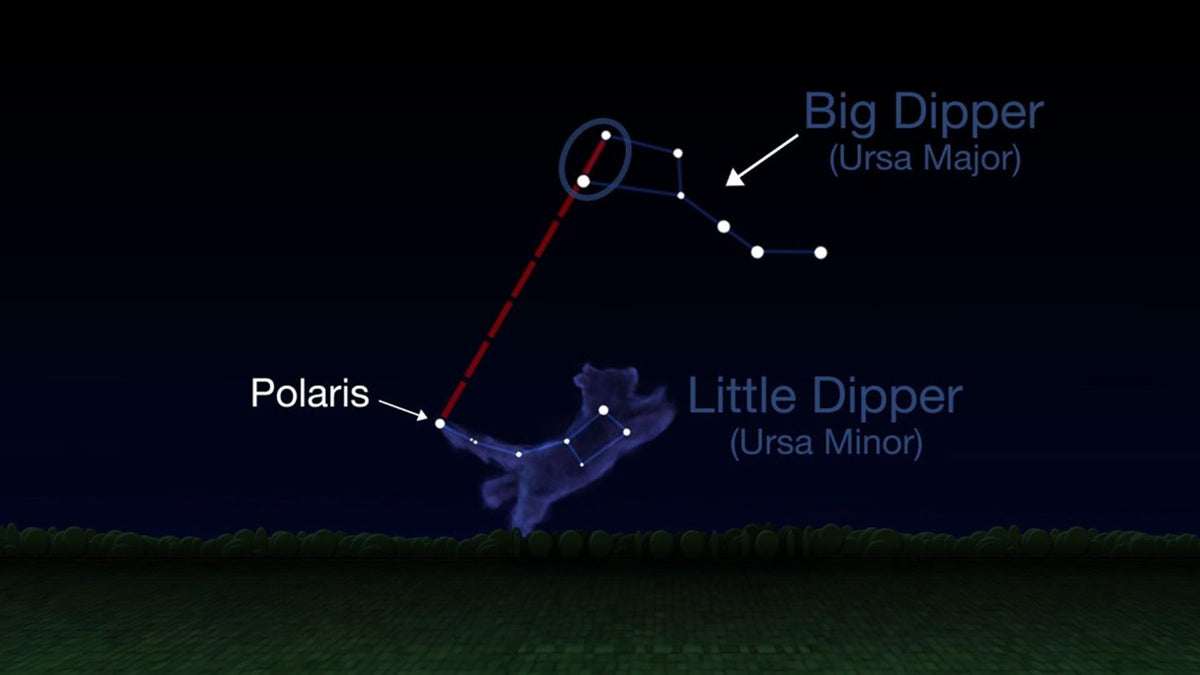
Cover: the Big Dipper’s pointer stars lead toward Polaris in this sky diagram. Courtesy NASA/JPL-Caltech; reproduced without alteration under the image use policy. Shown to explain the star reference, not as a diagram of a ritual sword. NASA, JPL, and Caltech do not endorse TaoWards.
Seven pale dots run along the blade of a sword preserved in the National Museum of Taiwan History. They represent a pattern you may have seen above your own neighborhood: the Big Dipper. On this sword, the stars become part of an object used to ward off harmful influences in religious rites.
A Seven Star Sword brings the Northern Dipper’s sacred significance into a ritual of protection. Its Chinese name, Beidou Qixing Jian, means Northern Dipper Seven Star Sword. To understand it, follow the connection from the night sky to sacred images, then to the blade a Taoist priest holds during a ceremony.
The seven stars you can recognize in the sky
The Big Dipper is a pattern of seven stars within Ursa Major, the Great Bear. Four form its bowl and three form its handle. In Chinese, Beidou means Northern Dipper: the same ladle-like shape gives the star group its name.
The sky diagram above shows another useful relationship. A line through the two stars at the outer edge of the bowl leads toward Polaris, the North Star. Polaris belongs to the Little Dipper, a separate pattern. NASA’s guide to finding the North Star explains how those two pointer stars help an observer face north.
That distinction keeps the symbolism clear. The seven marks on a Seven Star Sword refer to the Big Dipper. Polaris helps explain the modern association with finding direction, while the Dipper itself has a religious identity that goes much further than navigation.
When stars become divine figures
In Taoist worship, the Northern Dipper is associated with the course and protection of human life. People address its stellar deities in prayers concerning adversity and longevity. The Daoist Culture Centre’s account of longevity offerings describes scripture recitation, offerings, and lamp rites connected with this belief.
The same account places those rites in recognizable family circumstances: an elder’s birthday, advancing age, or worry about a relative’s well-being. The distant stars become part of a very close concern—the wish for someone to have more peaceful years ahead.
Art makes this relationship visible. A painting dated 1454, discussed in the Metropolitan Museum of Art’s introduction to Taoist art, presents the Northern and Central Dipper deities as human figures. These star gods belong to a heavenly order depicted through officials and other divine ranks.
This gives the dots on the sword a religious meaning. They call to mind divine powers to whom prayers can be addressed. Seeing those dots as a sign of the star gods helps explain why they belong on a protective sword.
How the sword became a ritual instrument
A sword already carries associations of command and defense. Taoist ritual gives that authority a sacred purpose. A fa jian is a ritual sword: an implement used within religious ceremonies to confront harmful forces and call on divine assistance.
The Daoist Culture Centre’s account of ritual swords cites a manual that describes making a sacred sword, reciting invocations, and engraving Dipper and star signs upon it. The instructions bring together an object, sacred words, and celestial imagery. They help explain why stars belong on the blade: the marks participate in the sword’s religious purpose.
The Centre also describes swords used to summon heavenly generals and drive away harmful spirits. In that setting, holding the sword is part of performing a rite. The priest acts within a tradition of prayers, divine names, and ceremonial authority.
The stars identify the divine powers associated with the sword; its blade gives the act of confronting harmful forces a visible form. That is how the two parts work together in its protective symbolism.
Looking closely at a museum sword
The National Museum of Taiwan History’s Seven Star Sword, accession 2006.003.0159, has a metal blade, wooden handle and scabbard, and copper fittings. Its catalog identifies three kinds of decoration.
Seven dots on the blade
Seven pale circles on each side represent the Big Dipper. These marks give the sword its name and identify its celestial association.
A fierce creature at the guard
The guard resembles a creature gripping the blade in its open mouth. The museum identifies it as Yazi, a fierce figure among the dragon’s nine sons in Chinese lore. Its face sits where the hand meets the blade.
A curved ruyi-head shape finishes the handle, while a dragon decorates the red-and-gold scabbard. Star signs, a fierce creature, and ornamental forms share this one object.
Protection at the altar and in everyday surroundings
Another collection brings the sword’s uses into focus. The Museum of World Religions describes a Seven Star Sword with seven studs symbolizing the Northern Dipper. Its account links the implement with Celestial Master Zhang, a revered Taoist teacher associated with protection, and notes that swords may also carry talismanic writing.
The museum records use for a priest’s protection and describes swords hung high in folk practice to ward off harmful influences. These settings connect the object with two related concerns: carrying out sacred work and keeping a place safe from disturbance.
Seen through these recorded uses, the fierce shape has a protective aim. The hope behind the weapon is for harmful forces to be restrained so that people can live in peace.
That context is part of learning to read the symbol. A sword raised in a ritual setting carries a different intention from a sword shown in a battle scene. The stars, the accompanying sacred signs, and the setting help tell us what kind of authority is being expressed.
What someone might keep close today
For a Taoist, the Seven Star Sword can express faith in divine protection and respect for the tradition in which it is used. A person whose family observes these customs may also connect it with a familiar temple, a household image, or someone who taught them its name.
For others, the combination of stars and sword can invite a personal reflection: what do I want to protect, and what direction do I want to follow? The star reference can recall orientation; the sword can stand for the resolve to act on a choice. These contemporary meanings can sit alongside an understanding of the symbol’s religious roots.
Imagine reserving Tuesday evenings for a class you have wanted to take for years. When another work request arrives, you reach for the calendar and hesitate. A symbol associated with direction and resolve might recall the reason you enrolled, helping you ask whether this new demand deserves the time you had set aside.
For someone else, the promise may be a Sunday visit to a parent that keeps getting postponed. Remembering the visit while there is still time to go gives “protecting what matters” a small, practical form. The personal meaning lives in that choice.
Wearing the symbol is one way to keep such a promise close. For someone drawn to the sword’s protective meaning, our Seven Star Sword pendant carries that motif into daily life—a reminder of the people and commitments they want to make time for.
The seven dots are a useful place to begin and to return. They link a recognizable sky pattern with a sacred instrument and, through it, with people’s wishes for protection and peace. Once you notice them, the sword becomes easier to read: a commanding shape carrying a concern for life.