
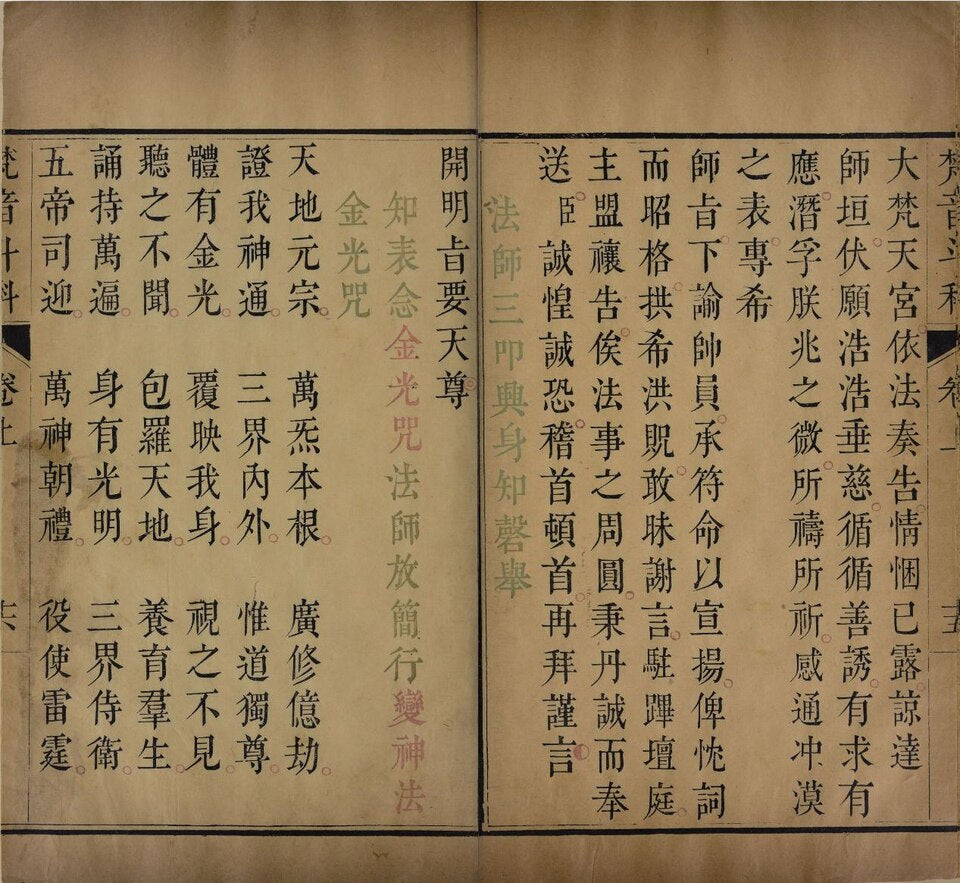
Cover: the opening of the Golden Light Invocation in Lou Jinyuan's Fanyin Douke, a Qing-dynasty multicolour printed edition. Scan page 20, from a copy held by the Chinese University of Hong Kong Library; public-domain scan via Wikimedia Commons. Original text and page layout preserved.
“There is golden light within my body, covering and illuminating me.” The image is at the heart of the Golden Light Mantra, a Taoist prayer also known as Jin Guang Zhou. But the prayer begins somewhere much larger than the person speaking: with heaven, earth, and the source of life.
That movement gives the text its meaning. Before asking for protection, it places the practitioner within a sacred world that sustains living things. Following its words helps explain what golden light represents, why the invocation is recited, and what someone might mean by keeping its words close today.
A prayer with a place in Taoist religious life
The full Chinese name is Jin Guang Shen Zhou. Jin guang means “golden light”; shen zhou identifies a sacred invocation. “Golden Light Mantra” is a familiar English name, while “Golden Light Invocation” makes its prayerful character easier to recognize. Both names refer here to the same Taoist text.
A version appears in the first volume of the Taishang Sandong Shenzhou, a collection of Taoist invocations, under a section devoted to thunder rites. In that setting, thunder belongs to a divine world whose powers are invoked to confront harmful forces. The prayer’s later references to thunder and protective deities grow out of that religious setting.
The invocation also has a place in present-day worship. Five Immortals Temple’s morning scripture book includes it on pages 7–8, with Chinese text and a pronunciation guide. It sits among other recitations in a longer morning service. A reader encountering one line on its own is therefore seeing part of a prayer that also has a communal, spoken life.
Reading the prayer, one movement at a time
The passages below follow the temple’s morning text. The English renderings are our translations of selected lines, offered to explain their imagery.
Heaven and earth come first
The opening describes “the mysterious source of heaven and earth, the root of all qi.” Qi is often translated as “vital breath”: in this worldview, it is fundamental to life and to the formation of the world. Here, the prayer directs attention toward the source that gives rise to everything.
It then speaks of cultivation over vast stretches of time and declares the supremacy of the Tao. The Tao, often translated as “the Way,” is the sacred source and order to which the practitioner turns. Cultivation means the ongoing work of religious practice and inner development.
This opening gives the protective request a particular foundation. The speaker first acknowledges something greater than an individual wish, then turns toward it through practice. Protection is placed within a relationship with the Tao.
Golden light surrounds the body—and sustains life
The next image is intimate: “There is golden light within my body, covering and illuminating me.” The prayer moves from the whole universe to the person reciting it. The same passage says this light cannot be seen by looking or heard by listening, then describes it as encompassing heaven and earth and nurturing living beings.
Those surrounding lines matter. They give golden light a sacred meaning beyond its color. It is protective, but also life-sustaining; the person seeking shelter belongs to the world the light embraces.
The Daoist Culture Centre’s explanation connects golden light with the Tao and with the practitioner’s cultivation and accumulated virtue. Within this religious understanding, the protective light expresses an inward commitment made visible. The wish for protection goes alongside the care taken with one’s actions.
Later, “reciting and holding it ten thousand times” makes persistence part of the prayer’s imagery. The repeated return to the words places golden light within an ongoing devotional life.
The final appeal calls for protection
The tone then grows more forceful. Divine attendants appear, thunder is summoned, and harmful spirits are described as losing their power. These are religious images of protection against threatening forces.
For a reader unfamiliar with Taoist ritual, the change can be surprising. The opening’s language of life and cultivation leads into the language of divine authority. Together, they present a world in which life can be nurtured and what threatens it can be restrained.
The morning text ends with an appeal for golden light to appear swiftly and protect the zhenren, literally the “true person,” a Taoist term for spiritual realization. After moving through heaven, earth, the body, and the divine realm, the prayer closes on the person seeking its shelter.
From morning recitation to the ritual altar
The morning scripture book shows one setting: an invocation recited within an established sequence of worship. A passage in a historical ritual manual shows a different use of its closing lines.
In the Qing-dynasty Fanyin Douke, compiled by Lou Jinyuan, a passage brings a written Golden Light sign together with recited words and ritual gestures. It uses the invocation’s closing imagery of thunder and golden light, ending with a request to protect the ritual space. Here, protection extends to the place where the ceremony is being performed.
This also helps explain two names a reader may encounter. Jin Guang Zhou names the invocation; Jin Guang Zhuan refers to a written talismanic form associated with golden light. A talisman is a sacred written sign used in religious practice. The spoken words and the written form can work together within a rite, while remaining different elements of it.
In these settings, the words belong to a larger practice involving texts, actions, and religious knowledge. Someone wishing to learn formal recitation can approach a Taoist temple or teacher and learn the invocation in that setting.
What it can mean to keep these words close
For a practicing Taoist, the invocation can express trust in divine protection and a commitment to cultivation. An inscription associated with it may carry that connection beyond the hours spent in worship. Its meaning can also be personal: a reminder of a temple visited with family, or of a prayer first heard from someone important.
For a reader approaching the text through culture, the relationship between protection and care offers another point of connection. The light that shelters the speaker is also described as nurturing living beings. That gives the image an outward-looking quality.
Think of a difficult conversation in which you need to hold your ground. Perhaps you are asking someone to stop speaking to you harshly. You want to be firm, yet feel yourself reaching for a cutting reply. Remembering this image could be a personal cue to keep your boundary without losing concern for the person in front of you. That is one contemporary way of reflecting on the text, rather than a ritual instruction.
For someone who wants to keep that reflection close, our Golden Light Invocation pendant carries an excerpt of the prayer. Knowing what the words say gives the inscription a personal connection: it can recall the wish to hold your ground while remaining considerate of others.

A light with both strength and care
The Golden Light Mantra begins with the source of life and ends with an appeal for protection. Between those two points, it joins cultivation, nurturing light, and the authority to confront harm.
Reading that whole movement gives the familiar image of golden light its depth. To those who hold it sacred, it expresses a protective presence rooted in the Tao. To a newcomer, it opens a way to understand how Taoist prayer brings the care of the self into a much larger vision of life.